
Vulkan continues to evolve as the gold standard for low-overhead GPU access, and 1.4.328.0 emphasizes developer productivity with smarter configuration options, refined validation, and seamless integration across ecosystems.

LunarG at QCon 2025: Elevate Your Influence
At QCon 2025, Brad Grantham talked about transitioning from an individual contributor to a strategic influencer.
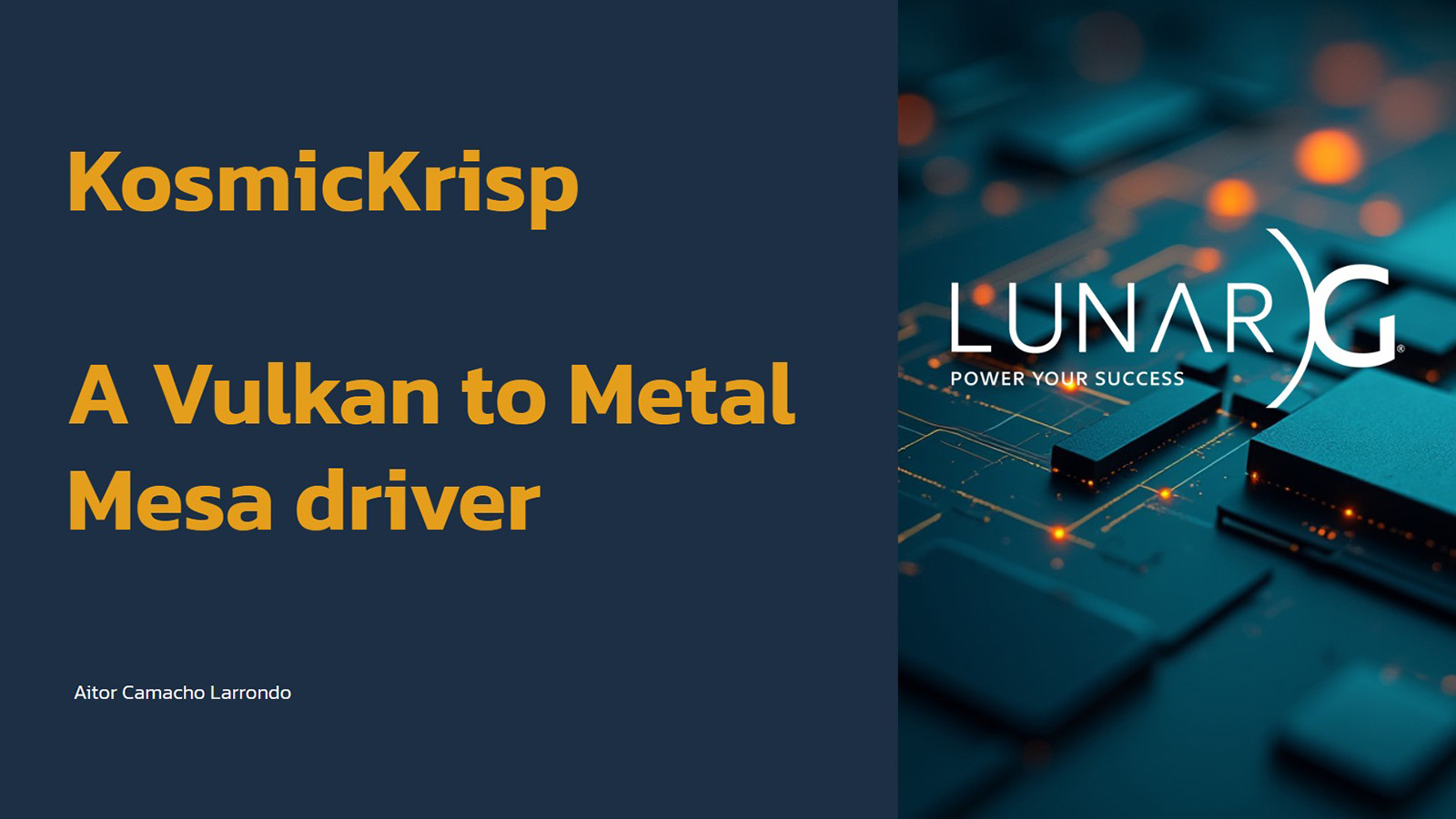
LunarG at XDC 2025: KosmicKrisp Overview
At XDC 2025, LunarG presented an overview of KosmicKrisp. Slides and a link to the video presentation are now available.
LunarG Releases Vulkan SDK 1.4.328.0
Vulkan continues to evolve as the gold standard for low-overhead GPU access, and 1.4.328.0 emphasizes developer productivity with smarter configuration options, refined validation, and seamless integration across ecosystems.
LunarG at SIGGRAPH 2025: Updates on Ecosystem and GFXReconstruct
At SIGGRAPH 2025, LunarG presented updates on the Vulkan SDK and ecosystem and described capture and replay of Vulkan and OpenXR commands with GFXReconstruct.
LunarG Releases Vulkan SDK 1.4.321.0
Vulkan SDK 1.4.321.0 Released: New Extensions, SPIR-V Tools Update, and Molten VK 1.3 Released 15 July, 2025 We’re thrilled to announce the release of the Vulkan SDK 1.4.321.0, packed with exciting new features, extensions, and improvements to empower developers with greater flexibility and performance in graphics and compute applications. This release, announced on July 15, 2025, aligns with the Vulkan Working Group’s ongoing commitment to advancing the Vulkan API. Let’s dive into the key updates in this release! Vulkan 1.4.321.0 SDK released New Extensions in Vulkan 1.4.321.0 The Vulkan headers now include a robust set of new extensions, offering developers optional features to enhance rendering, presentation, and video processing capabilities. Note that these extensions are optional and depend on support from the underlying driver or Installable Client Driver (ICD). Applications can query for the presence of these extensions to leverage their functionality. The new extensions are: VK_KHR_present_mode_fifo_latest_ready: Introduces a tear-free presentation mode (VK_PRESENT_MODE_FIFO_LATEST_READY_KHR) similar to VK_PRESENT_MODE_FIFO_KHR, optimized for time-based presentation APIs. Developed by NVIDIA and Google, this extension enhances frame pacing for smoother visuals. VK_KHR_surface_maintenance1: Adds window system integration features omitted from the original VK_KHR_surface extension, including querying min/max image counts, scaled presentation capabilities, and switchable presentation modes without swapchain recreation. VK_KHR_swapchain_maintenance1: Enhances VK_KHR_swapchain with features like per-present mode changes, fence signaling for resource cleanup, and deferred memory allocation for better startup performance and memory efficiency. VK_KHR_video_encode_intra_refresh: Expands Vulkan Video encoding with intra-refresh capabilities, enabling advanced video encoding workflows. VK_SEC_pipeline_cache_incremental_mode: Introduces incremental pipeline cache updates for improved performance. VK_ARM_data_graph: Provides ARM-specific data graph functionality for optimized processing. VK_OHOS_surface: Adds support for OHOS (Huawei’s operating system) surface integration. VK_VALVE_fragment_density_map_layered: Enables layered fragment density mapping for advanced rendering techniques. VK_KHR_maintenance9: Includes minor maintenance updates to improve API robustness. VK_KHR_present_id2: Enhances presentation identification for better frame tracking. VK_KHR_present_wait2: Replaces VK_KHR_present_wait, offering per-surface queryable wait functionality for improved latency control. VK_KHR_unified_image_layouts: Simplifies image layout management for more efficient resource handling. VK_KHR_video_decode_vp9: Adds VP9 video decoding support to Vulkan Video. VK_ARM_tensors: Introduces ARM-specific tensor processing capabilities. VK_EXT_shader_float8: Enables 8-bit floating-point operations in shaders for reduced memory usage. VK_ARM_format_pack: Optimizes format handling for ARM architectures. VK_EXT_zero_initialize_device_memory: Allows zero-initialized device memory for simplified resource management. VK_KHR_robustness2: Enhances robustness features for more reliable application behavior. Developers can query these extensions using vkEnumerateDeviceExtensionProperties to check for driver support, ensuring compatibility across diverse hardware. SPIR-V Tools Update: Canonicalize-IDs Pass The spirv-remap utility from glslang has been ported to the SPIRV-Tools repository as a new optimization pass called canonicalize-ids, available in spirv-opt. This pass offers functionally equivalent ID canonicalization for SPIR-V code, streamlining shader processing. Developers can access usage details by running spirv-opt –help. The spirv-remap utility in glslang is now deprecated and will be removed in the next SDK release, so we encourage transitioning to the canonicalize-ids pass for future-proofing your workflows. Improved Validation Coverage Validation layers have been enhanced with updated VUID (Valid Usage ID) coverage. The accompanying documentation (validation_error_database.csv and validation_error_database.html) now reflects the latest validation layer status, helping developers identify and resolve API usage issues more effectively. These updates ensure robust error checking and compliance with Vulkan specifications. MoltenVK Updated to Version 1.3.0 MoltenVK, the Vulkan implementation for Metal on macOS and iOS, has been upgraded to version 1.3.0. This update brings full support for Vulkan 1.3 along with multiple new extensions, significantly boosting compatibility and performance for Apple platforms. For detailed changes, refer to the MoltenVK release notes. Thank You to Vulkan Ecosystem Contributors! We extend our heartfelt gratitude to all the contributors in the Vulkan ecosystem—developers, engineers, designers, and community members—who have played a vital role in making the Vulkan SDK 1.4.321.0 release possible. Your dedication to advancing the Vulkan API through innovative extensions, robust tools, and rigorous validation ensures that developers worldwide can create cutting-edge graphics and compute applications. Special thanks to the teams at NVIDIA, Google, ARM, Valve, and countless others for their contributions to the new extensions, MoltenVK updates, and SPIR-V tools enhancements. Your collaborative spirit drives the Vulkan community forward, and we’re excited to see what you’ll help us achieve next! Get Started with Vulkan SDK 1.4.321.0 The Vulkan SDK 1.4.321.0 is a significant step forward, offering new tools and extensions to enhance graphics and compute development. Whether you’re optimizing video encoding, improving presentation latency, or targeting new platforms like OHOS, this release has something for every Vulkan developer. Download the SDK today from the Vulkan SDK download page and explore the full potential of these updates. Tell us how we can assist you! Share your feedback, questions, or project ideas with the Vulkan community to help shape the future of this powerful API. Stay tuned for more updates, and happy coding! Release Notes Release Notes for Linux Release Notes for Windows Release Notes for macOS About LunarG GPU software development teams often run into roadblocks they can’t move on their own. LunarG is the industry’s leading problem-solving partner for GPU programming. We provide the tools, expertise, and passion you need to keep moving forward and deliver innovative, quality products. Visit the LunarG website to learn more.
LunarG Demonstrates OpenXR Support for GFXReconstruct at AWE 2025
Today at Augmented World Expo 2025, LunarG announced initial OpenXR API support for its widely used GFXReconstruct tool. See the full press release here. OpenXR is the industry’s top API for creating portable, immersive XR experiences. GFXReconstruct is the GPU software industry’s leading developer tool for capturing and replaying API call streams, a capability that supports tasks like defect analysis, API usage review, performance profiling, and regression testing. By adding OpenXR API support to GFXReconstruct, LunarG aims to streamline workflows for XR developers, helping them build and deliver applications more efficiently. Today through June 12, attendees of AWE 2025 can visit booth #609, adjacent to the Khronos® Group booth, to see a live demonstration of GFXReconstruct capturing and replaying OpenXR API calls. This proof-of-concept showcases LunarG’s expert capabilities by enabling better debugging, analysis, and optimization for XR applications. “With this proof-of-concept, we’re empowering XR developers with new visibility into immersive application performance and behavior,” said Karen Ghavam, CEO and Engineering Director. “LunarG can customize the OpenXR support in GFXReconstruct to a company’s specific use cases – helping them successfully develop next-gen XR applications.” About LunarG GPU software development teams often run into roadblocks they can’t move on their own. LunarG is the industry’s leading problem-solving partner for GPU programming. We provide the tools, expertise, and passion you need to keep moving forward and deliver innovative, quality products. Visit the LunarG website to learn more. Go to the Vulkan SDK Download site to get the new SDKs

LunarG Releases Vulkan SDK 1.4.313.0
Vulkan SDK 1.4.313 Release: New Extensions, Cross-Platform Enhancements, and More Released 06 May 2025 The Vulkan SDK 1.4.313 release has landed, bringing updates across Linux, Windows, and macOS platforms (download here). Announced on May 6, 2025, this release introduces new extensions, enhances cross-compiling capabilities, improves validation coverage, and upgrades tools like vkconfig3. Whether you’re a game developer, a graphics engineer, or working on compute applications, this update offers valuable additions to streamline your workflow. Let’s break down the key changes in this release. Deprecation Notices The May 2025 SDK release is the last release of Ubuntu Packages. As Ubuntu Packages become older than two years, they will be removed from public availability. Visual Studio 2019 will be deprecated in the future and when this happens, SDKs will require the use of Visual Studio 2022. New Vulkan Extensions The Vulkan headers in SDK 1.4.313 now include the following new extensions, which are optional and may not be supported by all drivers or ICDs (Installable Client Drivers). Applications can query for these features to ensure compatibility: VK_QCOM_tile_memory_heap VK_NV_external_compute_queue_vendor VK_QCOM_tile_shading VK_EXT_fragment_density_map_offset VK_KHR_shader_bfloat16 These extensions expand Vulkan’s flexibility, catering to diverse use cases from mobile optimization to machine learning. Developers should query for support using Vulkan’s enumeration functions (e.g., vkEnumerateDeviceExtensionProperties) to ensure compatibility with target hardware. Enhancements to vkconfig3 The Vulkan Configurator (vkconfig3) sees multiple improvements, making it a more robust tool for debugging and configuration: Dark Mode Support: For Windows and macOS, a new dark mode option improves usability in low-light environments, reducing eye strain during long development sessions.Variations in Linux distributions are making proper Linux support problematic. We are continuing to pursue a Linux solution for this oft-requested feature. Removal of vkVIA: The vkVIA tool has been deprecated, with its diagnostic functionality now integrated into the System Diagnostic tab of the Vulkan Configurator, streamlining the diagnostic process. Log File Creation: vkconfig3 can now generate log files specifically formatted for submission with Vulkan bug reports, simplifying the process of reporting issues to driver vendors or the Khronos Group. Additional Enhancements: The vkconfig changelog details further improvements, such as UI tweaks and performance optimizations These updates make vkconfig3 a more user-friendly and efficient tool for managing Vulkan layers and settings, which is crucial for debugging complex graphics applications. Cross-Compiling Enhancements (Windows Only) The Windows release of Vulkan SDK 1.4.313 includes significant improvements for cross-compiling, catering to developers targeting both x64 and ARM64 architectures: Windows/x64 SDK: Now includes Windows ARM libraries and DLLs in the Lib-ARM64 and Bin-ARM64 directories, allowing developers to cross-compile for ARM64 devices from an x64 system. Windows/ARM SDK: Includes Windows/x64 libraries and DLLs in the Lib-X64 and Bin-X64 directories, enabling cross-compilation for x64 systems from an ARM setup. Developer Responsibility: The SDK provides the necessary libraries and DLLs for linking and packaging, but no additional tools (e.g., compilers) are included. Developers must configure their own cross-compilation toolchains, such as using Visual Studio with ARM64 support. This cross-compiling support is a big win for Windows developers, enabling them to target a broader range of devices—like ARM-based laptops or mixed-architecture deployments—without needing separate build machines. However, the lack of bundled tools means you’ll need to be comfortable setting up your own environment. Improved Validation Coverage (All Platforms) All three SDK releases (Linux, Windows, macOS) include enhanced validation layers, a critical component for catching errors in Vulkan applications: Updated Validation Documentation: The validation_error_database.csv and validation_error_database.html files have been updated to reflect the latest VUID (Validation Unique ID) coverage status. This documentation helps developers understand which Vulkan API rules are enforced by the validation layers, making it easier to debug and optimize code. Broader Coverage: More edge cases and API misuse scenarios are caught by the validation layers. This reduces the likelihood of runtime errors in production applications. Stronger validation is especially useful for developers new to Vulkan, as it helps identify mistakes early in the development process, saving time and effort. Why This Release Matters The Vulkan SDK 1.4.313 release strengthens Vulkan’s position as a versatile, cross-platform API for graphics and compute. The new extensions cater to emerging needs, like efficient mobile rendering (Qualcomm extensions) and machine learning (bfloat16 support), while also supporting advanced rendering techniques (fragment density map offsets). The cross-compiling enhancements for Windows are a practical addition for developers targeting diverse architectures, and the improvements to vkconfig3 and validation layers make debugging easier than ever. Together, these changes empower developers to build more efficient, robust applications across Linux, Windows, and macOS. Getting Started Download the latest Vulkan SDK from https://vulkan.lunarg.com. The SDK includes the updated headers, libraries, validation layers, and tools like vkconfig3, along with sample code to help you explore the new extensions. Be sure to check the vkconfig changelog for a full list of enhancements, and review the validation documentation to understand the updated coverage. Final Thoughts Vulkan SDK 1.4.313 is a solid update that balances new features with practical improvements. While the new extensions are optional and hardware-dependent, they signal Vulkan’s ongoing evolution to meet modern demands. The cross-compiling support and enhanced tools like vkconfig3 demonstrate a commitment to developer productivity, though Windows developers will need to invest time in setting up their cross-compilation environment. Whether you’re optimizing for mobile, experimenting with machine learning, or debugging a complex render pipeline, this release has something to offer. A Big Thank You! LunarG is grateful to every contributor in the Vulkan Ecosystem—your efforts power these SDKs and make them a reality! Release Notes Release Notes for Linux Release Notes for Windows Release Notes for macOS About LunarG GPU software development teams often run into roadblocks they can’t move on their own. LunarG is the industry’s leading problem-solving partner for GPU programming. We provide the tools, expertise, and passion you need to keep moving forward and deliver innovative, quality products. Visit the LunarG website to learn more.