

Now Available – Vulkan 1.4.309.0 SDKs Released 13 March 2025 LunarG is excited to announce the release of Vulkan SDK 1.4.309.0 for Linux, Windows, and MacOS! Supporting Vulkan API revision 1.4.309, this SDK update brings a host of enhancements designed to streamline your graphics development workflow. Whether you’re debugging shaders, optimizing performance, or exploring new extensions, this SDK has something for you. Key enhancements in this version include: Vulkan Validation Layer error messages get a major upgrade—now clearer, more actionable, and easier to digest due to a standardized format. The Vulkan Configurator levels up with slick new features, aimed at improving developer productivity. Ten new extensions join the lineup, expanding your creative toolkit. Validation coverage sees a boost, helping you catch more issues with less hassle. Go to the Vulkan SDK Download site to get the new SDKs Revamped Validation Layer Messages: Clarity Meets Flexibility Debugging just got a lot friendlier. We’ve overhauled the Validation Layer error messages to make them more human-readable and actionable: New Format: Errors now follow a clean, three-line structure—VUID and metadata on the first line, the core message on the second, and spec text with a URL on the third. Say goodbye to cluttered object lists! Warnings On by Default: Core Validation now enables warnings (like Undefined Values) out of the box, helping you catch issues early without disrupting existing setups (e.g., VK_DEBUG_UTILS_MESSAGE_SEVERITY_ERROR_BIT_EXT users are unaffected). JSON Output Option: Prefer structured data? Enable JSON output for VkDebugUtilsMessengerCallbackDataEXT::pMessage and parse it with ease. Sync Validation Upgrade: Synchronization validation errors are now easier to understand, with an optional key-value properties section for simpler filtering—configurable via vkconfig or the khronos_validation.syncval_message_extra_properties setting. These changes mean less time deciphering errors and more time building. Check out all the details here. Vulkan Configurator: Enhanced Usability and Reliability The Vulkan Configurator (vkconfig) has been improved with features that boost usability and stability: Loader Commands: Import, export, delete, and apply stored loader configs with new vkconfig loader commands. Stay Updated: Get notified when a newer SDK drops, so you’re always on the cutting edge. Quality Boost: Numerous fixes enhance reliability Whether you’re tweaking settings or managing configs, vkconfig is now a smoother ride. New Extensions to Explore The Vulkan headers now include ten fresh extensions, unlocking new creative possibilities (note: driver support varies, so query availability): VK_NV_present_metering VK_NV_cooperative_vector VK_NV_cluster_acceleration_structure VK_NV_partitioned_acceleration_structure VK_NV_ray_tracing_linear_swept_spheres VK_EXT_external_memory_metal VK_KHR_video_maintenance2 VK_ARM_pipeline_opacity_micromap VK_KHR_depth_clamp_zero_one VK_KHR_maintenance8 From ray tracing enhancements to video and memory improvements, these extensions give you more tools to push graphics boundaries. Platform Updates and Deprecation Notice Ubuntu Packages Winding Down: Starting summer 2025, we’ll phase out Ubuntu-specific packages due to limited demand. This SDK and one more will be the final releases. The Linux tarball remains a versatile alternative for all Linux devs—check the Getting Started Guide (link-to-guide) for supported distros. DXC Holdback: Ubuntu 24.04 packages for SDK 1.4.304.0 won’t update DirectXShaderCompiler due to a stack corruption issue. Need the latest DXC features? Switch to the Linux tarball executable. A Big Thank You! LunarG is grateful to every contributor in the Vulkan Ecosystem—your efforts power these SDKs and make them a reality! Release Notes Release Notes for Linux Release Notes for Windows Release Notes for macOS About LunarG Looking to elevate your GPU software project with expert optimization, customized development tools, or Vulkan mastery? LunarG combines industry-leading technical knowledge with a proven track record of supporting developers and hardware vendors. Our services include consulting, customization, or staff augmentation. Visit the LunarG website to learn more.
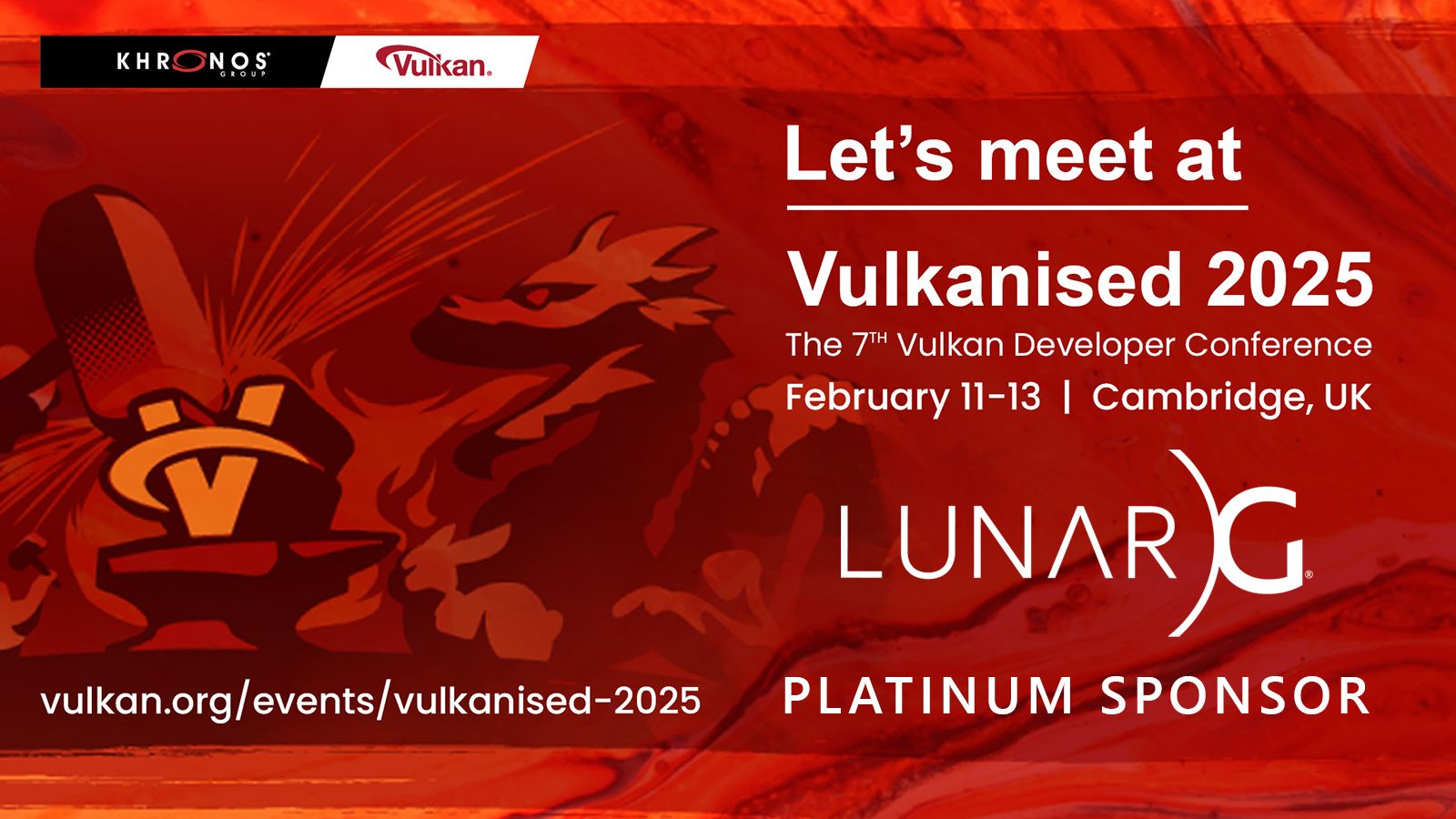
Vulkanised 2025 – LunarG Technical Presentations
At Vulkanised 2025 in Cambridge | UK, LunarG presented the following technical presentations: Watch the Videos – Vulkan SDK – Enhancements Over the Last Year – by Karen Ghavam, CEO & Engineering Director Debugging your GPU Workflow – by Spencer Fricke, Graphics Software Engineer Vulkan Crash Diagnostic Layer – by Jeremy Gebben, Senior Graphics Software Engineer Vk-Bootstrap: Vulkan Project Startup Made Easy – by Charles Giessen, Graphics Software Engineer So You Want to Write a Vulkan Renderer in 2025 – by Charles Giessen, Graphics Software Engineer Download the Presentations – Vulkan SDK – Enhancements Over the Last Year – by Karen Ghavam, CEO & Engineering Director Debugging your GPU Workflow – by Spencer Fricke, Graphics Software Engineer Vulkan Crash Diagnostic Layer – by Jeremy Gebben, Senior Graphics Software Engineer Vk-Bootstrap: Vulkan Project Startup Made Easy – by Charles Giessen, Graphics Software Engineer So You Want to Write a Vulkan Renderer in 2025 – by Charles Giessen, Graphics Software Engineer
LunarG Releases Vulkan SDK 1.4.304.1 – vkconfig3, GFXReconstruct ray tracing, ++docs, ++Slang
Now Available – Vulkan 1.4.304.1 SDKs Released 7 Feb 2025 Today, we dropped a new Vulkan SDK for Windows, Linux, and macOS that adds significant new features across all three versions: A new version (v3) of the Vulkan Configurator that provides a ton of useful new features Improvements to GFXReconstruct that allow ray tracing capture/playback in a portable manner Documentation improvements that provide massive speedups in load times An updated version of Slang containing a variety of bug fixes and improvements Go to the Vulkan SDK Download site to get the new SDKs Vulkan Configurator v3 Some of the big improvements to the Vulkan Configurator include: Numerous improvements to loading and selecting layers Improvements to layer ordering Enhancements to executable lists Additional logging support for Vulkan Loader UI and system diagnostics improvements Improvements to $(VULKAN_SDK) variable coverage Note that previous versions of Vulkan Configurator will no longer be supported. GFXReconstruct Support for Portable Ray Tracing Device-independent capture and replay of ray tracing commands (capturing on one device and replaying on a different device) has proven challenging due to the differences in support for ray tracing functionality. GFXReconstruct now contains support for capture-time tracking of device buffer device addresses, shader group handles, and acceleration structures in order to correctly replay them later on a different device. Antora version of Vulkan Specification The Vulkan Working Group has developed a version of the Vulkan specification using Antora. With this release, the Antora-based version of the Vulkan specification has been integrated into the SDK version-specific specification of the LunarXchange SDK documentation. This greatly improves load times for documentation within a browser. The single file HTML version of the Vulkan Specification has been removed from the SDK due to serious usability issues. In a future SDK release, the “chunked” and PDF versions of the specification will also be removed. Slang An updated version of the Slang shading language compiler is included in this release. This version adds DescriptorHandle for bindless handle support. Thank you! LunarG would like to thank all the contributors to the Vulkan Ecosystem that help make the SDKs possible! Release Notes Release Notes for Linux Release Notes for Windows Release Notes for macOS About LunarG LunarG makes it easy for you to tap into the power of GPU processing without straying from your mission to deliver compelling software to your customers. We offer training, consulting, and developer tools for the GPU ecosystem. Vulkan-specific expertise includes performance analysis and tuning, runtime and tools development, shader optimizations, driver development, and porting engines and applications to Vulkan. Visit the LunarG website to learn more.
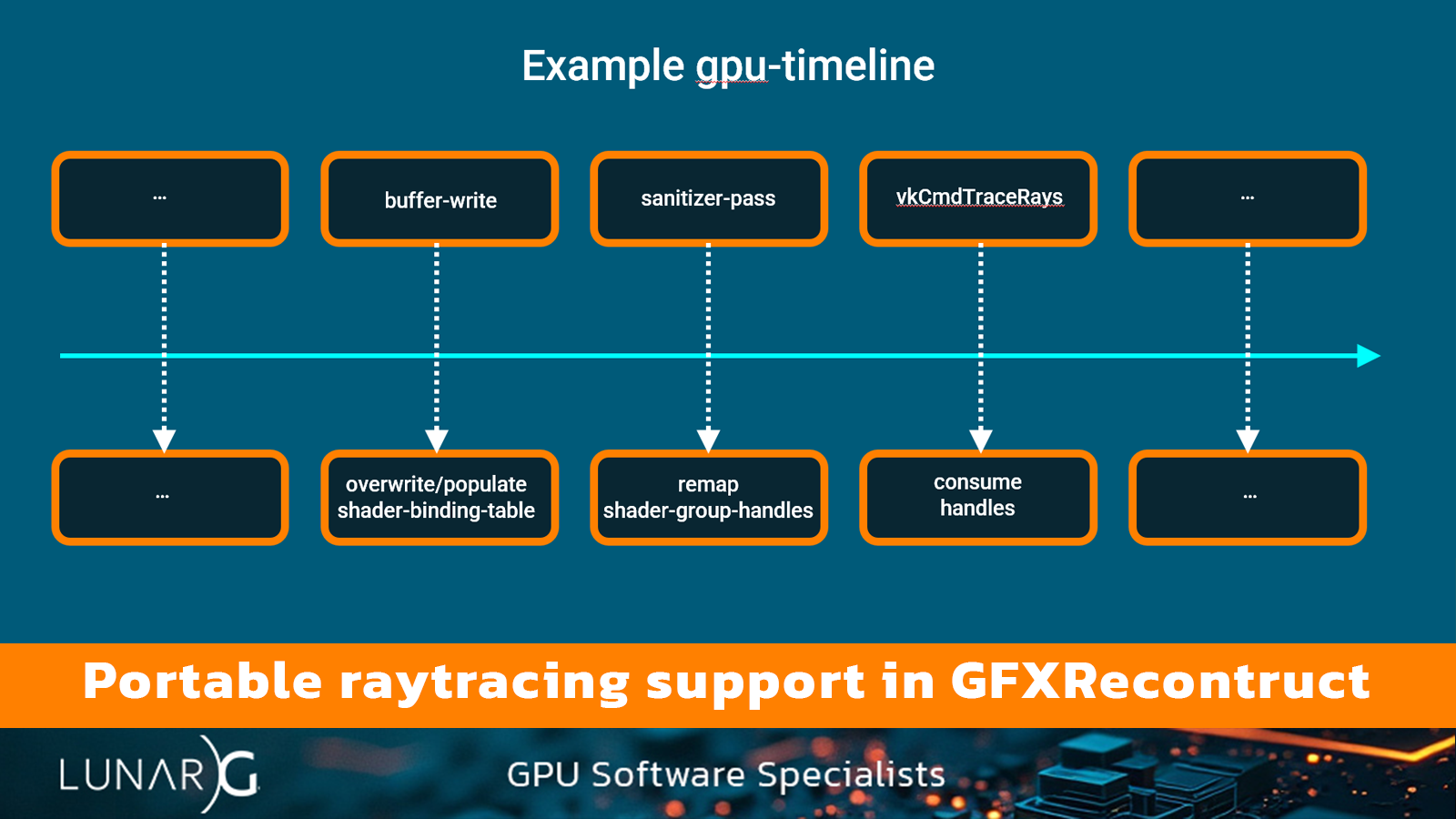
Portable Raytracing with GFXReconstruct
Capturing and replaying ray-tracing commands in a device-independent manner has been challenging. However, Vulkan developers can now benefit from a solution we’ve implemented in GFXReconstruct. This advancement allows for the capture of ray tracing commands on one device and their accurate replay on another. Check out Fabian’s white paper for details on how we achieved this!
2024 Ecosystem Survey – Progress Report Released!
Hey everyone! Today we are releasing our 2024 Ecosystem Survey Progress Report. This document describes how we’ve used the feedback you provided last year in our efforts to improve the Vulkan ecosystem. A big part of running these surveys is making sure you all feel like your voices are being heard and that we’re actually doing something with the info you give us. We work on this every year to close the loop, which also gets folks excited to join in on the next survey right after we drop the yearly progress report. (And the 2025 survey is now live, so help us out by taking a few minutes to fill it out!) In this blog post, we’ll hit the highlights of what we achieved over the last year, but do yourself a favor and check out the full report. There’s some cool notes in there on how your feedback shaped our work. Notably: Many of the accomplishments described below are thanks to the folks at LunarG, made possible with support from Valve and Google. The Khronos dev relations crew has been grinding away to improve the Vulkan specs, samples, and docs. (They are responsible for the awesome Antora work described below.) The Khronos Vulkan Working Group continues to explore options to reduce API verbosity and complexity. And let’s not forget the awesome open-source devs who’ve contributed so much. Big shoutout to everyone for all we’ve done together over the last year! Background The 2024 LunarG ecosystem survey was a collaborative effort between LunarG, Khronos developer relations, and Google to assess the Vulkan ecosystem’s health and developer satisfaction. The survey targeted a broad spectrum of Vulkan developers, both SDK users and non-users, through multiple channels including social media, developer communities (e.g., Reddit and Discord), professional networks, and direct email to over 13,000 recipients. Survey results from 2024 helped prioritize Vulkan implementation priorities and design decisions over the past year. Vulkan Ecosystem Progress (Feb. 2024-Jan. 2025) SDK Releases The biggest contribution to ecosystem progress came from six Vulkan SDK releases over the last twelve months. Turning the crank on each release requires effort and coordination from a big team of people. Hundreds of improvements and bug fixes go into each release. Significant effort is required to curate and align almost 30 major components, test things, package them up, and make them available to thousands of users worldwide. The Vulkan SDK is now supported on Windows, Linux, macOS, and Android. And it is downloaded 50,000 times every week! This level of usage makes it essential that every release is high quality. In addition to the continuous improvements from six releases, here are some specific results achieved since the 2024 Ecosystem Survey. Platform Support Windows 11 is now fully supported and is included in LunarG’s CI and SDK release test matrix. Added an SDK for ARM64 on Windows 11 and a script to enable Linux users to support ARM64. The macOS SDK is now dual platform (Apple Silicon/X86_64) and the installation can be automated more easily. Added iOS support to the macOS SDK. SDK tools Significantly improved GFXReconstruct (improved support for Android, major performance improvements, added interactive analysis features, merged foundations of portable capture and replay of ray tracing). Included support for Slang to address the need for next generation shading languages. Added a new crash diagnostic layer to provide a straightforward method for diagnosing and fixing GPU hangs and crashes. Improved GPU-AV and Debug Printf so they can be used simultaneously and added support for 8-, 16-, and 64-bit float. Added debug labels and resource handles to error messages. The SDK documentation now includes an alternative version of the Vulkan specification built using Antora. This Antora-generated specification significantly reduces load times when accessed via a browser. Now, clicking a URL link from a validation layer error message will quickly direct you to the relevant VUID section in the Vulkan specification, bypassing the slow loading times associated with the HTML version. This feature is introduced in SDK version 1.4.304.1. Validation Completed a significant amount of development for SPIR-V validation. Completed and released synchronization validation for the VK_KHR_timeline_semaphore extension. Modified the working group process to require validation layer support for new extensions coincident with their release. Completed all core validation rules for Vulkan 1.0, 1.1, and 1.2. Completed all ray tracing validation that can be done on the CPU. Documentation and Samples Improved Vulkan documentation by adding a dark mode, improved searching, and eliminating dead links. Made significant additions to Vulkan’s shading language documentation. Added programming samples for raytracing, interoperability, video, and for six new extensions Improved support for extension/feature queries. Conclusion Supporting an open-source initiative like the Vulkan SDK allows companies to innovate faster, reduce costs, and quickly develop enterprise-quality, cross-platform GPU software solutions. LunarG and our partners are proud of what we have accomplished on behalf of the Vulkan ecosystem in the last 12 months. Let’s make 2025 another great year for the Vulkan API and the Vulkan SDK!

Vulkan GPU-assisted validation startup time improved by >10X
When you create a pipeline in Vulkan, the graphics driver compiles the SPIR-V code from your application into assembly code that the GPU can execute. Given that applications can have tens of thousands of these pipelines, the speed of compilation is crucial. When tracing application execution with GFXReconstruct, all these pipelines are compiled at the beginning of the trace, which can significantly slow down the process. The Challenge with GPU-AV GPU-AV, our GPU validation tool, requires instrumenting the SPIR-V code with additional validation and error reporting instructions. Initially, this instrumentation caused performance issues, with each pipeline taking multiple seconds to compile, and the entire trace taking hours to start with GPU-AV enabled. Although subsequent runs were faster due to shader caching by the driver, we needed to enhance the initial startup time. Our Optimization Strategies Here are the four main strategies we employed to accelerate the process: Leveraging the “DontInline” Flag: SPIR-V includes a “DontInline” flag for functions. We found that most drivers ignored this flag. Inlining generally improves application performance. But with NVIDIA’s 553.31 Windows Driver, Setting this flag gave us a 10x speed increase, reducing compilation time for small traces from 205 seconds to just 32 seconds. The speedup occurred because GPU-AV instrumented the same function multiple times, and the driver’s inlining was counterproductive. Segmenting Instrumentation: We divided the large, monolithic instrumentation into smaller, more targeted checks. This allowed us to skip unnecessary instrumentation, particularly in scenarios where certain features like descriptor indexing weren’t used. This approach significantly improved performance for applications with limited use of advanced GPU features. Utilizing Vulkan Robustness Features: To prevent application crashes, GPU-AV would wrap every potentially invalid SPIR-V instruction in an if/else construct. This was computationally expensive. By adopting Vulkan’s robustness features, we could delegate crash prevention to the hardware, thereby simplifying and speeding up our instrumentation. Optimizing for Graphics Pipeline Libraries: Previously, we instrumented each library in the Graphics Pipeline Library individually. However, since many libraries might not be used during a trace, we shifted the instrumentation to occur at the library linking phase (typically at draw time). This not only distributed the compilation load over time but also reduced unnecessary instrumentation. Bonus: Parallel Pipeline Compilation: GFXReconstruct recently introduced a command line option for parallel compilation of pipelines, which, while still in beta, has dramatically increased compilation speeds. (Contact us for more details.) Conclusion These optimizations have significantly reduced the overhead of using GPU-AV for Vulkan pipeline validation, making it more practical for developers to use in their workflows without substantial delays. We continue to refine and enhance these processes to ensure both performance and reliability in GPU validation tasks.

LunarG 3D graphics engineer adds GLSL & SPIR-V as inputs to Compiler Explorer!
Innovation Flash! Spencer Fricke, a 3D graphics engineer at LunarG, has added GLSL & SPIR-V as input options to the popular Compiler Explorer (a.k.a. Godbolt) tool. To see what we mean, checkout these examples – GLSL – https://godbolt.org/z/s14W5Mx6M spirv-opt – https://godbolt.org/z/r1j1GnMer spirv-val – https://godbolt.org/z/ePbTaYK3r Stay tuned for more valuable innovations from LunarG 3D graphics engineers! FYI – Download the Vulkan SDK here!
2023 Vulkan Ecosystem & SDK Survey – End of Year Status Report
In February of 2023, LunarG conducted a Vulkan Ecosystem & SDK Survey. Many Vulkan developers shared their requests for improvements. LunarG took those suggestions to heart and made many enhancements to the Vulkan ecosystem this year. We’ve prepared a report for the Vulkan developer community that summarizes our work. Read on for more information.