
September 25, 2025
Today we are proud to announce that KosmicKrisp, LunarG’s Mesa Vulkan driver for Apple silicon, has passed the Vulkan 1.4 Conformance Test Suite (CTS) and is now a Khronos-conformant Vulkan 1.4 implementation. The Vulkan 1.4-conformant version of KosmicKrisp will be available for download in the Vulkan SDK releasing September 29.
KosmicKrisp was already a Khronos-conformant Vulkan 1.3 product. Vulkan 1.4 conformance is the next step in advancing support for Vulkan on macOS. In addition to reaching 1.4 conformance, substantial support for non-core extensions and features has been added, including Tesselation, Robustness2, and Multi-draw. KosmicKrisp is implemented as a Mesa driver, shipped in the LunarG Vulkan SDK, and exercised in LunarG’s CI. Performance of KosmicKrisp has tripled since it achieved Vulkan 1.3 conformance, and optimization work continues to be a high priority.
What this means
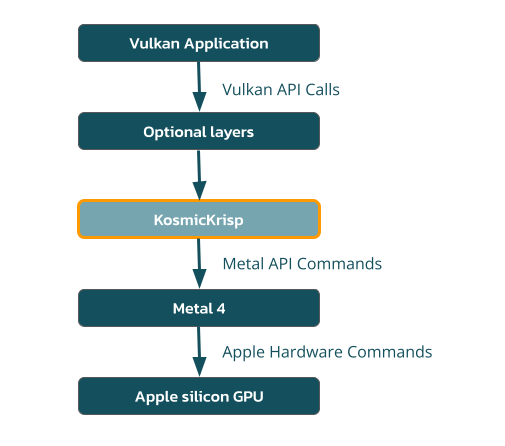
For supported Apple silicon systems, developers can target Vulkan 1.4 the same way they target it on other desktop platforms. The application speaks Vulkan. The loader and layers stay standard. KosmicKrisp is the ICD that implements Vulkan on Metal 4.
Passing CTS is the proof point. The suite is Khronos’s required test of API correctness across core functionality, synchronization, resource management, and shader execution. A passing, accepted submission is what allows an implementation to be listed as conformant.That listing matters in practice. For example,
- Engines can keep a single Vulkan 1.4 path that runs on Windows, Linux, and Apple macOS systems.
- Tools that expect a conformant ICD—validation layers, capture and replay, diagnostics—have a first-class target on the Mac.
- The Google Android Emulator and other demanding workloads can depend on a driver that is specified, tested, and conformant.
Where KosmicKrisp sits
KosmicKrisp is a Mesa Vulkan driver. Shaders go through Mesa’s NIR intermediate representation and are emitted as Metal Shading Language. Command buffers are encoded to Metal 4.On the system it occupies the ICD slot.
MoltenVK remains available in the macOS SDK for Intel Macs and older operating systems. KosmicKrisp is the conformant Mesa path for current Apple silicon. It is also the path LunarG builds and tests in CI.
What you need to run it
- Hardware: Apple silicon (M1 and later). Not Intel Macs.
- OS: macOS 26 or later (Metal 4).
- Distribution: LunarG Vulkan SDK, in the homebrew package of Mesa releases, or a Mesa build with -Dvulkan-drivers=kosmickrisp.
- Selection: Point the loader at the KosmicKrisp ICD, for example:
export VK_DRIVER_FILES="$VULKAN_SDK/share/vulkan/icd.d/libkosmickrisp_icd.json"
Then confirm with vulkaninfo or Hardware Caps Viewer.
KosmicKrisp is a Mesa Vulkan driver that is open-source and MIT-licensed. It is not an Apple system driver. Applications that ship on mixed Mac fleets (older Intel hardware and newer Apple silicon) can still bundle MoltenVK and choose the ICD from hardware and OS at runtime.
How we got here
KosmicKrisp started from a blank slate in late 2024, reached a passing Vulkan 1.3 CTS in 2025, and was listed as a Khronos-conformant 1.3 product in October 2024. It merged to Mesa, shipped in the macOS Vulkan SDK, and has been picking up engine-facing features and performance work ever since—tessellation, extended dynamic state, push descriptors, indirect draws, subgroup operations, Metal 4 encoding, and substantial submit-path improvements.
Vulkan 1.4 support was exposed in Mesa and in the SDK once the remaining 1.4 requirements, including timestamp coverage, were in place and the CTS was clean. Now KosmicKrisp is officially Vulkan 1.4 conformant.
The project exists because Mesa is an ideal place to build a Vulkan driver: leveraging Mesa’s compiler stack, shared Vulkan runtime, in-tree tools, and a community that already reviews this class of code. Google’s sponsorship helped make the original effort possible, including for Vulkan on the Android Emulator on Mac. LunarG continues to design, implement, and maintain the driver.
Regarding iOS Support
We have built KosmicKrisp for iOS, run it against samples and application workloads, and enabled the Vulkan CTS on iOS. Results were strong, but the conformance test suite was not fully passing.
iOS is not enabled or supported in this release. Shipping an iOS build would imply that community issues and pull requests will be handled. LunarG is not currently resourced to support iOS in addition to macOS. We also treat CI as a requirement for production quality, and the iOS test infrastructure is not in place yet.
That said, iOS CTS results for KosmicKrisp were substantially better than for MoltenVK. If you need iOS now, you can build the driver yourself and try your application. There is a strong chance it will run. KosmicKrisp still requires Metal 4.
Acknowledgements
Thanks to the KosmicKrisp team and to everyone who tested early SDK drops, filed issues, and sent Mesa reviews. Particular thanks to Aitor Camacho Larrondo and the LunarG driver and SDK engineers who took this from first compute tests to a listed 1.4 implementation, to the Mesa community, and to Google for supporting the work that got this driver off the ground.
Vulkan is a cross-platform API. With KosmicKrisp, Apple silicon is on that map for Vulkan 1.4, not as a special case, but as a conformant target.