
2025 in Review: Advancing the Vulkan Ecosystem Together
With the conclusion of 2025 (and with Vulkan’s 10th anniversary on the horizon in 2026!), the LunarG team reflects on a year of meaningful progress in the Vulkan SDK, validation layers, tools, and platform support. Guided by your valuable input from the 2025 LunarG Ecosystem Survey, we prioritized stability, usability, performance, and broader accessibility. Here’s a summary of the key advancements we delivered—and where we’re headed next.
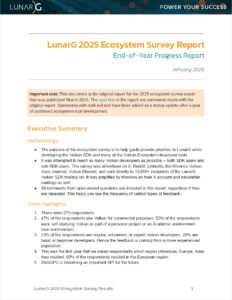
(The 2025 progress report is included as in-line commentary on the 2025 Ecosystem survey. Read the entire document as a PDF. Highlights of the progress report are included in this post.)
Frequent SDK Releases: Keeping Pace with Vulkan’s Evolution
In 2025, LunarG delivered six full Vulkan SDK releases within the 1.4 series (from 1.4.304.0 in January through 1.4.335.0 in December), maintaining a steady cadence of roughly every 1–2 months. In addition, several other quick patch releases addressed urgent fixes or refinements.
This frequent update rhythm ensures developers stay current with the latest Vulkan API extensions (50+ added in 2025), validation improvements, tooling enhancements, and platform support additions without long waits. By shipping incremental updates regularly, we enable faster adoption of new Vulkan features, quicker bug resolutions, and more seamless integration of community-driven advancements like KosmicKrisp. The result is reduced friction in development workflows, better alignment with the evolving Vulkan specification, and stronger ecosystem momentum as Vulkan continues to mature.
Platform Support & Portability: Bold Steps Forward
We made strategic moves to better serve diverse platforms:
- Vulkan on Metal: Introducing KosmicKrisp — A major highlight of 2025 was the release of KosmicKrisp, our new Vulkan-to-Metal layered driver built on the Mesa Vulkan framework. Already Vulkan 1.3 conformant, KosmicKrisp eliminates many limitations of previous portability approaches. It enables faster Vulkan API evolution by leveraging Mesa’s robust tooling and community. By reducing reliance on Vulkan Portability™, we’re accelerating high-quality Vulkan experiences on Apple Silicon.
- Ubuntu Packages — As of July 15, 2025, we discontinued building Ubuntu-specific packages to reallocate resources toward expanding CI regression testing across our many Vulkan repositories. This ensures higher overall quality as the ecosystem grows.
Validation Layer Enhancements: Stronger, Faster, More Complete
Our validation layers remain the cornerstone of reliable Vulkan development, and 2025 saw continued refinement:
- GPU-Assisted Validation (GPU-AV) — Performance optimizations rolled out steadily throughout the year, making GPU-AV more practical for everyday debugging. Our engineers’ current focus is expanding coverage to mesh shading and ray tracing pipelines, ensuring comprehensive GPU-side checks for these advanced features.
- Improved Error Message Format — One of the top developer complaints from prior surveys and community feedback was the readability and actionability of validation layer messages. In SDK 1.4.309.0 (March 2025), we delivered a major overhaul: errors now use a clean, standardized three-line structure—VUID with metadata and object list on the first line, the core actionable message on the second, and relevant spec text plus a direct link on the third. Synchronization validation messages were also reworked for better human readability, with optional key-value properties to simplify suppression and filtering. These changes make debugging significantly friendlier and faster, directly addressing long-standing pain points.
These improvements directly respond to survey feedback calling for better performance and fewer spurious errors in validation tooling.
Tooling & Workflow Improvements: Making Development Smoother
We invested heavily in making our tools more intuitive and powerful:
- Vulkan Configurator (vkconfig) — Early in 2025, we launched vkconfig3, featuring a clean, tab-based UI that simplifies layer and setting management for all users.
- In SDK 1.4.335.0, we added driver selection controls, giving developers explicit power over which Vulkan drivers their applications use—especially helpful in multi-GPU or mixed environments.
- Discoverability got a boost with a new “Documentation” tab linking directly to the Vulkan Configurator Readme and the Vulkan Tutorial, reducing friction for newcomers and veterans alike.
- Slang Integration — Slang continues to evolve rapidly. To keep pace without delaying SDK releases, the slang project team has begun to version their libraries and this is now included in the SDK.we’ve shifted to providing versioning features in Slang itself. Developers can now rebuild components with the latest Slang updates and integrate them easily—empowering more frequent experimentation while maintaining SDK stability.
Documentation, Tutorials, and Samples
In 2025, the team led by Marty Johnson of Khronos made substantial improvements to Vulkan documentation, tutorials, and samples to address quality, completeness, optimization guidance, and relevance—delivering more beginner-friendly, production-relevant, and educator-useful resources under a holistic documentation plan The developer user experience was improved by optimizing documentation access times, and docs.vulkan.org now loads much faster. Other highlights include:
- Modernized official Vulkan Tutorial with Vulkan 1.4 baseline, dynamic rendering, timeline semaphores, Slang shaders, and cross-platform (desktop/mobile) best practices
- Expanded coverage of advanced topics: Ray Tracing, GLTF loading, mipmapping, depth buffering, multi-threaded rendering, and Android development
- New section demonstrating Vulkan Configurator (vkconfig) for external validation-layer management with practical code examples for cleaner applications
- Added ~12 new samples (more planned for early 2026), most now with vulkan-hpp versions and Slang shaders
- Released complex real-world synchronization sample + tutorial in the Vulkan Tutorial GitHub repo, showcasing a full game engine with PBR, Forward+ clustered lighting, Ray Query shadows/rendering, animated GLTF, HRTF audio/physics in compute, async image uploads, and background-thread texture streaming
Continuing the Momentum in 2026
As we look ahead, we’re excited to build on this momentum—celebrating a decade of Vulkan at Vulkanised 2026, pushing GPU-AV coverage further, refining KosmicKrisp, improving Vulkan learning materials, and continuing to act on your survey feedback.
Complete EOY Report
You can access the complete EOY status report here. This document contains the full set of comments from LunarG at the time the 2025 LunarG Ecosystem Survey was completed (April 2025) and our end of year comments describing the progress we made.
Thank You!
Thank you to the Vulkan community for your insights, contributions, and enthusiasm. Your survey responses directly shaped our 2025 priorities, and we’re planning some things aimed at taking the conversation to another level in 2026.
Download the latest Vulkan SDK at vulkan.lunarg.com and join the conversation on our channels.
Here’s to continued progress in 2026!
— The LunarG Team